 By admin
 Prediabetes is far more than a minor health alert; it is a full-blown crisis where your bloodstream begins to thicken, your cells lock their doors against insulin, and your pancreas burns out from working overtime.
This is precisely why your glucose monitor spikes after dinner, why your energy levels vanish by mid-afternoon, and why your body feels weighed down by exhaustion. You might feel fine one day, only to wake up to a blood sugar reading that feels like a terrifying wake-up call.
The grim reality is that your system is currently drowning in excess sugar, overwhelmed by internal stress, and deprived of the essential nutrients needed to process energy correctly. The silver lining? Your body possesses an incredible ability to heal itself once you stop fueling the fire.
The five-step strategy discussed here isn’t based on magic tricks or expensive fads. It’s a hard, necessary reset for the biological machinery that has been struggling to regulate your blood sugar for months or even years.
The first thing that breaks is the sugar pipeline
When prediabetes takes hold, every meal rich in carbohydrates acts like a massive traffic jam. Processed foods, sugary beverages, and refined starches hit your system like a truckload of heavy fuel dumped into a failing engine.
Imagine your arteries as a highway after a major accident; traffic might still crawl forward, but everything stalls, overheats, and creates a massive bottleneck. This is exactly what happens when glucose levels skyrocket and your cells stop responding to the signals meant to let them in.
By cutting out the sugar surge and swapping it for fiber-dense nutrition, you fundamentally alter the landscape. Fiber works as a natural speed bump for glucose, ensuring that sugar enters your bloodstream in slow, manageable waves rather than a destructive, sharp spike.
Instead of the typical post-meal “crash” that leaves you feeling shaky, confused, and desperate for snacks, you experience consistent energy throughout the afternoon. Your jittery hands stabilize, and the mental fog induced by high blood sugar finally begins to clear.
Why movement hits the pressure point so hard
Your muscles act as giant glucose sponges. When you engage them, they begin soaking up excess sugar like dry towels dropped into a puddle, pulling that heavy fuel out of your bloodstream and putting it to work rather than letting it sit and cause damage.
This is the primary reason why a daily walk, a light bike ride, or even short bursts of activity can transform your metabolic health. You aren’t just “burning calories” for the sake of it—you are manually opening a drainage valve for your blood sugar.
Wall Street doesn’t profit from you taking a walk after dinner, which is precisely why the most effective, low-cost fix receives the least amount of media attention.
Visualize the difference between a house with clogged gutters and one with clear, functional downspouts. In the clogged home, water backs up and rots the foundation. In the clean home, the water flows freely and the structure remains sound.
This is what consistent movement does for your blood sugar. It prevents glucose from pooling where it causes the most harm, and eventually, your body stops reacting to every single meal as if it were a life-threatening emergency.
The hidden damage is happening while you sleep
Stress hormones act like gasoline thrown onto a smoldering fire. When your nervous system remains stuck in “fight or flight” mode, cortisol forces sugar into your bloodstream as if a constant alarm bell were ringing in your body.
This is why your nights become restless. You collapse into bed exhausted, yet your body remains internally frantic. Your sleep quality suffers, your recovery is halted, and you start the next morning feeling even more depleted and inflamed than the day before.
This is why stress management and quality sleep are not “luxury upgrades.” They are non-negotiable components of your metabolic health. Without deep rest, there is no chance for a reset. Without a reset, there is no relief.
Think of your metabolism as a warehouse with a faulty security system. Loud noises trigger flashing lights, sirens, and chaos. Quality sleep silences that alarm, providing the quiet necessary to organize your internal inventory.
Once you achieve this, you won’t necessarily see a movie-style miracle overnight. Instead, you will notice fewer energy crashes, diminished sugar cravings, and mornings where you don’t wake up feeling like you were hit by a freight train.
Why the meter matters more than guesswork
Prediabetes thrives in the shadows. You can feel perfectly “normal” while your internal numbers are quietly slipping into the danger zone, and by the time you experience obvious symptoms, significant damage may have already accumulated.
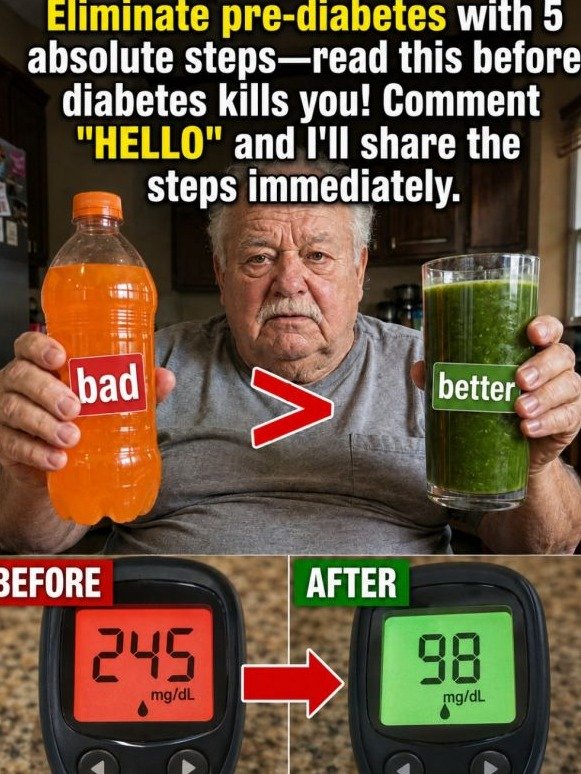
This is why home glucose monitoring is a game-changer. It converts invisible metabolic chaos into concrete, actionable data. You no longer have to guess or blame yourself; you can see exactly which habits and meals are triggering your dangerous spikes.
It’s equivalent to installing high-beam headlights on a road you’ve been driving in total darkness. Suddenly, the curves are visible, the hazards are identified, and the collision you were heading toward can be avoided entirely.
With time, this feedback loop becomes your greatest tool. You discover exactly what stabilizes your health, what triggers your issues, and how to stop viewing your body as an unpredictable, broken mystery box.
The solutions weren’t hidden from you; you were simply distracted by overly complex wellness fads that made you overlook the brutally effective power of the basics.
The part most people botch before it starts working
One common kitchen mistake ruins the entire process: pairing “healthy” ingredients with hidden sugar bombs. A smoothie packed with fruit concentrate, a “low-fat” pastry, or refined grains disguised as “wholesome” can spike your glucose faster than a slice of cake.
That is the trap. Your body takes a hit, the meter climbs, and people blame their metabolism rather than the meal itself.
Use your next meal to stabilize your system rather than inflame it. Prioritize protein, fiber, and movement after eating to fundamentally shift how glucose is absorbed. That final step is the secret weapon most people never get to hear about.
The next phase is where things get truly interesting: there is a specific food pairing that can completely alter your body’s metabolic response once you understand the science behind it.
This article is for informational purposes only and does not replace professional medical advice. Please consult your healthcare provider for personalized guidance.