 By admin
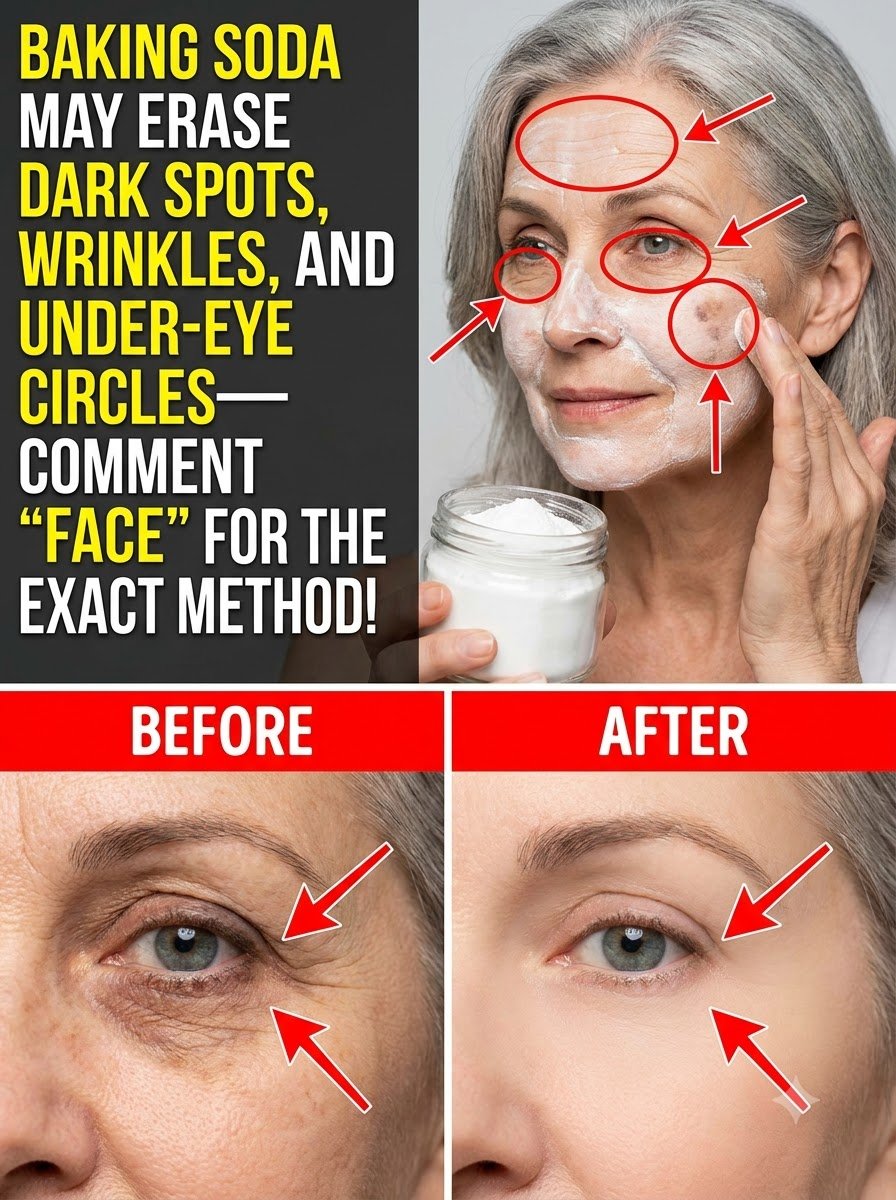
 Using baking soda on your skin acts like a microscopic abrasive shockwave. It’s an incredibly seductive promise: unsightly dark spots fade away, fine lines appear softened, and those weary, hollow shadows under your eyes seem to vanish overnight.
This is exactly why so many people turn to this kitchen staple the moment the mirror reveals a face that looks significantly older than they feel. We’re talking about those persistent brown patches on the cheeks, the deep crinkles forming around the mouth, and the dark, sunken half-moons under the eyes that make every morning look like a total disaster.
However, what you rarely hear is that baking soda is not a magic eraser. While it might alter the skin’s surface quickly, if your skin barrier is already compromised, fragile, or dehydrated, this DIY hack can turn a minor imperfection into a major, inflamed problem.
The real story isn’t whether it “works” in the moment; it’s about the long-term damage it inflicts on your skin’s top layer when that layer is already hanging on by a thread.
Why dark spots look louder on stressed skin
Dark spots are essentially the skin’s way of crying out after years of sun damage, chronic irritation, or persistent inflammation. Think of your complexion like a wall that has been splashed, aggressively scrubbed, and patched over so many times that the finish looks uneven, tired, and dull.
Baking soda works by stripping away that top layer of skin. Initially, people notice a temporarily brighter appearance, simply because the dead skin cells are being pushed off like dust from a bookshelf.
But there is a harsh contrast here: when your natural barrier is already weak, that aggressive stripping leaves your skin exposed, dehydrated, and hyper-reactive. The dark spot might look lighter for a few minutes, but soon the surrounding area becomes angry, parched, and more blotchy than it was before.
This is why the under-eye area is a massive trap. The skin there is as thin as tracing paper; one harsh scrubbing session can leave it looking crepey and aged rather than refreshed.
It’s like trying to sand a delicate wooden table with coarse sandpaper because you want the stain gone instantly. The stain might blur, but you’ve effectively destroyed the integrity of the wood underneath.
Why wrinkles respond differently than people expect
Wrinkles are not just dirt sitting on the surface of your face. They are deep creases, dehydration lines, and structural folds that become more prominent as the skin loses its natural cushion and elasticity.
Baking soda does absolutely nothing to rebuild that structural cushion. It might create a short-lived illusion of smoothness by removing the flaky buildup that catches the light and makes lines appear deeper, but this is a superficial trick.
After a few applications, a clear pattern emerges: the skin begins to feel uncomfortably tight, looks flatter in certain areas, and eventually displays even more texture in others. That feeling of tightness isn’t youth returning; it’s your skin screaming for help.
Imagine a leather bag that has been wiped down too aggressively. It might look clean for a second, but the surface soon feels stiff, dry, and depleted. Your skin reacts in the exact same way when its protective barrier is pushed past its limit.
Many women notice this shift when their makeup starts acting up. Foundation begins clinging to dry patches, and concealer settles into those tiny under-eye lines like wet powder falling into the cracks of a concrete sidewalk.
The surface may look “smoothed” for a fleeting moment, while the underlying structural issue becomes significantly more pronounced.
The tired-eye area is where the illusion breaks
Under-eye darkness isn’t always just about pigment. It often stems from thin skin, shadowing, fluid retention, lack of sleep, or visible blood vessels showing through like wires under a thin sheet.
Baking soda does not change that anatomy. At best, it offers a slight polish by lifting away surface dullness.
At worst, it transforms the delicate under-eye zone into a dry, irritated patch that looks even more exhausted by the end of the day. The skin there is like tissue paper held up against a bright light; rough treatment makes every minor flaw stand out, not fade away.
This is the part that those glossy “before-and-after” photos conveniently leave out. They show the immediate, bright result, but they never show the rebound redness, the tightness, or the patchiness that follows when you bully your skin barrier.
Men often notice this shift first: the face feels “clean” for a moment, but then it starts looking rougher around the nose, cheeks, and eyes, as if the skin had been scrubbed with a abrasive kitchen sponge instead of treated with care.
When the barrier is stripped away, your face stops looking well-rested and starts looking raw and exposed.
What the skin actually needs instead
Your body already possesses the blueprint to repair its outer layer, but it requires the right biological building blocks and a calm environment to do so. A damaged skin barrier is like a brick wall with missing mortar; adding more scrubbing only causes the remaining structure to crumble.
True recovery isn’t about punishment; it’s about support. You need ingredients that soothe friction, lock in moisture, and allow the surface to heal without constant abrasion.
When your skin finally receives what it actually needs, the results are subtle yet profound. You’ll notice less burning after washing, less flaking around the nose, makeup that sits smoothly, and a face that no longer looks like it was caught in a wind tunnel.
Over time, your complexion looks less “haunted.” The dark spots might not vanish like a cheap parlor trick, but they stop standing out because the surrounding skin is no longer inflamed, red, and stripped of its health.
The skincare industry would lose billions if everyone realized how much a gentle, consistent routine can outperform the aggressive DIY hacks that are marketed as instant shortcuts.
Wall Street doesn’t build empires around simple, affordable, and boring solutions — even when those boring solutions are infinitely kinder to your face.
One small detail can wreck the whole effect
Using baking soda on dry skin, leaving it on for too long, or pairing it with other harsh scrubs turns a quick beauty trick into a full-scale assault on your barrier. This dangerous combination can make dark spots appear even more uneven and cause your under-eye skin to look dangerously thin.
The smarter path is always restraint, not force. Once your skin surface is already irritated, one extra round of scrubbing can flip your entire result from “brighter” to “raw.”
There is one specific pairing rule that changes everything about how your skin tolerates these treatments, and it’s the difference between a gentle surface polish and a downward spiral of permanent irritation.