 By admin
 Part 1: The Midnight Call
Imagine waking up to a chilling call in the dead of night, your own child sleeping soundly beside you, only to be told you’ve abandoned *another* baby. That’s precisely the terrifying reality that shattered my peace at 1:17 AM. My mother, Dorothy, was on the other end, her voice laced with confusion, asking a question that made my blood run cold: “What time are you coming back for the baby?”
For what felt like an eternity, I lay frozen in the darkness, the words echoing in my mind, refusing to make sense. My gaze slowly drifted to the other side of the bed, where my eight-month-old daughter, Catherine, was nestled. Her tiny hand was wrapped around my pajama top, her warm body a comforting weight against mine. She was right here. She was safe. She had never left my side.
“Mom, what are you talking about?” I finally managed to ask, pushing myself upright. “What baby?” A profound silence followed, a void more terrifying than any frantic explanation. My mother was a creature of habit, an early sleeper who never broke her routine, especially not for a late-night call unless it was a genuine crisis.
Then, her voice, barely a whisper, broke the silence. “You brought the baby over yourself.” Her tone trembled, raw with fear. “You said you were completely exhausted and needed a few hours of sleep. You left the diaper bag and the heavy carrier here, and then you just walked back out.”
A wave of icy dread washed over me. I instinctively pulled Catherine closer, her small form a fragile shield against an unseen threat. “Mom, I haven’t gone anywhere tonight. Catherine is right here with me.” I could hear her ragged breathing on the other end of the line, then she uttered words that sent my stomach plummeting: “Then whose little girl is sleeping in my living room?”
I leaped out of bed. “Stay inside. Lock the door. I’m coming right now.” Frantically, I dressed, bundled Catherine into a warm blanket, and rushed her to the car. The drive to my mother’s house in Oakwood felt like an eternity, each street light a blurry beacon in the pre-dawn darkness. I desperately tried to rationalize, to find a logical explanation. Had Mom confused someone else for me? She’d had a few minor memory lapses recently, nothing alarming, but enough to spark a flicker of concern. Or had someone simply left a baby at her doorstep?
But one chilling question relentlessly gnawed at me: How could anyone have known exactly how to deceive her?
When I finally reached her house, I didn’t even need to knock. The front door swung open. Dorothy stood there, barefoot and clad in her robe, her face utterly drained of color. “Please be quiet,” she whispered, her eyes wide with fear. “He just fell asleep.” I froze. “He?” She immediately shook her head, a tremor running through her. “I mean the baby. I don’t know why I said he.”
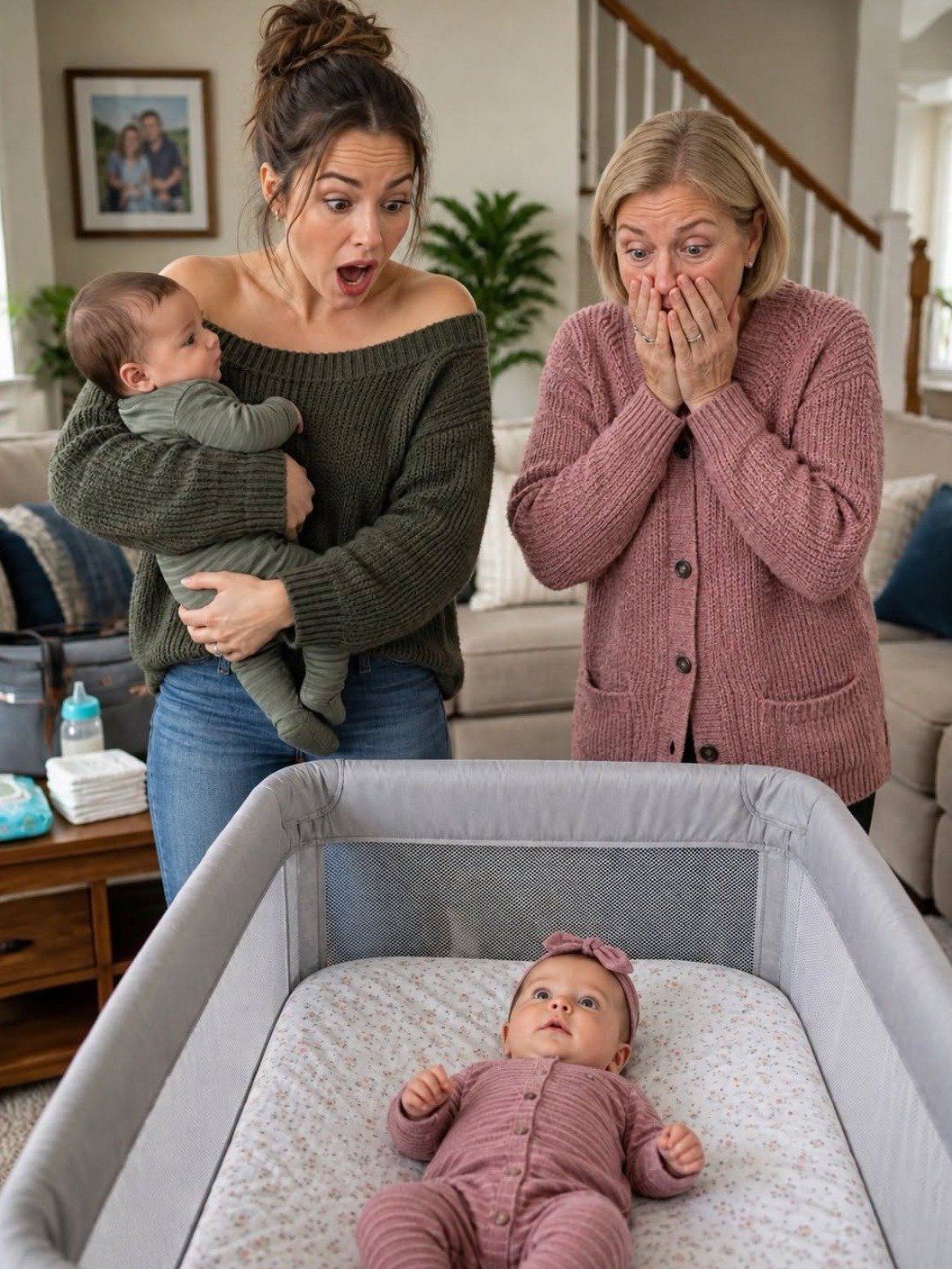
I followed her inside, the familiar scent of herbal tea, antiseptic soap, and baby powder doing little to calm my racing heart. Then I saw it: a portable travel crib, positioned squarely in the middle of her living room. My heart lurched. I recognized it instantly. It was *my* crib, stored in her attic months ago after Catherine had outgrown it.
Inside, a tiny girl slept peacefully under a pale pink blanket, dressed in a yellow onesie adorned with little daisies. My breath caught. It was almost identical to the outfit Catherine had worn earlier that day. Beside the crib sat a diaper bag. I knew it, too. Inside were the exact brand of baby wipes I used, a familiar bottle brush, extra diapers, and even an embroidered bib I’d thought I’d lost weeks ago. Someone hadn’t just abandoned a baby; someone had meticulously copied my daughter’s belongings. Someone had *planned* this.
“I could have sworn it was you,” Mom whispered, tears welling in her eyes. “You were standing near the flowerpot where the porch light doesn’t reach very well. You said, ‘Mom, please. Just give me a few hours.’ You sounded exactly like you.”
I slowly approached the crib. The little girl stirred in her sleep. Then I noticed it – something around her tiny wrist. A hospital identification bracelet. With trembling hands, I carefully lifted her arm and angled the bracelet toward the light. My blood ran cold. The surname printed on it was Richards. The same surname as my ex-husband, William Richards. The father of my daughter, Catherine. Below the surname was the baby’s name: Hazel Richards.
I stared at the name, a sickening realization dawning on me. William had barely been present in Catherine’s life since her birth, seeing his own daughter only twice in eight months. He’d always claimed he needed time to rebuild his life after our divorce, but in reality, he’d simply moved in with another woman, Pamela Foster. And now, his *other* baby was sleeping in my mother’s living room.
Before I could even reach for my phone, Hazel woke up. Her cry was weak, frightened. My instincts took over. I gently lifted her from the crib, and the moment I held her against my chest, she wrapped both tiny arms around my neck, clinging to me as if she already knew I would keep her safe. I looked at my mother, my voice firm despite the tremor in my hands. “Call the police.”
Fifteen minutes later, a patrol car pulled into the driveway, its red and blue lights casting an eerie glow through the windows. Officer Hughes entered, her gaze immediately sweeping over the scene: the crib, the diaper bag, the hospital bracelet, the travel carrier. I explained everything, Hazel still cradled securely in my arms. When I mentioned William’s name, Officer Hughes’s expression shifted. “We may have a connection,” she said carefully, explaining that police had responded earlier that night to a violent disturbance at Pamela Foster’s apartment. Pamela was gone, the apartment empty, but neighbors had reported seeing William leaving the building, carrying a large infant carrier.
My stomach tightened. Then my phone vibrated. A new message. From William. I opened it, and the words on the screen made my blood run cold:
“I knew you would know exactly what to do with the situation, so please, don’t let me down now.”
I stared at the message, then at Hazel, then thought of Catherine, safe in her bed at home. Suddenly, it all clicked into place. This wasn’t an accident. William had deliberately brought Hazel to my mother. He had dressed her in clothing eerily similar to Catherine’s. He had used my old baby supplies. He had exploited my mother’s trust. And somehow, he had even copied my voice. But one haunting question remained: Why?
I didn’t have to wait long for the answer. By dawn, the police had found William, and what they discovered with him revealed a plan meticulously crafted long before he ever arrived at my mother’s door.
Part 2: The Calculated Deception
Police located William just after sunrise, slumped asleep in his sedan, parked discreetly behind a cheap roadside motel several miles outside Oakwood. When officers opened the driver’s door, an empty liquor bottle lay conspicuously on the passenger seat. In the back, the damaged base of the infant carrier he’d used to transport Hazel was clearly visible. Officer Hughes roused him, and William blinked several times, confusion clouding his eyes. “What is this about?” he mumbled.
“You need to come with us,” one of the officers stated. William shook his head, defiant even in his disorientation. “I haven’t done anything wrong.” The officer’s reply was stark: “You left an infant with another woman in the middle of the night.” William’s expression barely flickered. “The baby was perfectly safe,” he asserted. “She was with family. My ex-wife always knows how to take care of everyone.” That sentence, repeated to me later by Officer Hughes, ignited a furious fire within me. William hadn’t trusted my kindness; he had coldly calculated to exploit it. He had banked on me seeing a helpless baby and prioritizing her safety above all else.
Later that morning, Pamela arrived at the police station, her face swollen from tears, an oversized jacket clearly not her own draped over her exhausted frame. Detectives questioned her, and Pamela revealed the truth: William had been hiding severe financial problems for months, drowning in debt from predatory loans. Collectors had been relentless. He had also lost his stable income but, instead of admitting his struggles, maintained a facade of normalcy, drinking heavily almost every night. When Hazel cried, his anger became terrifying.
“He kept saying the baby had ruined his life,” Pamela recounted to the detectives, her voice strained. “He said Hazel had destroyed his future.” She then described the harrowing events of the previous night. “Yesterday evening, I told him I was leaving him,” Pamela said, her voice trembling. “I told him I was taking Hazel with me.” She wiped her eyes. “He became furious. He pushed me away and grabbed Hazel from the crib.” The detective leaned forward. “What did he say?” Pamela swallowed hard. “He said he knew exactly where to take her.” She looked down at her hands, her voice barely audible. “He said, ‘There is a woman who would never abandon a baby.’”
That woman was me. William had known my family for years. He knew my mother kept extra formula and baby supplies at her house because Catherine sometimes stayed there. He knew where the old travel crib was stored. He knew my mother’s routines. And he knew the porch light left a dark, deceptive area near the large flowerpot. Most importantly, he knew something about my mother that he had no right to exploit: her unwavering trust in me. He knew if she believed she heard her daughter asking for help, she would open the door.
The doorbell camera later confirmed the chilling truth. The camera hadn’t captured William’s face clearly, as he had deliberately stayed in the darker part of the porch. But it captured his vehicle. And it captured his voice: “Mom, please. Catherine needs to sleep. Just open up.” My mother broke down when she heard the recording. “I really thought it was you,” she sobbed. I took her hand. “Mom, listen to me. He didn’t trick you because you’re weak.” She looked at me through her tears. “He tricked you because he knew you trusted me.” I squeezed her hand. “This isn’t your shame. It’s his.”
But one mystery still lingered: How had William gotten my daughter’s clothes, diaper bag, and other belongings? He hadn’t been allowed inside my house since our separation, and I had changed the locks shortly after our split. The answer arrived that afternoon. Security footage from my apartment building showed William entering two days earlier. He had used an old key he had never returned. I felt sick as I watched the footage. While I was out with Catherine, William had invaded my home. He had taken a large duffel bag, meticulously selecting enough of Catherine’s belongings to make his carefully constructed lie believable. He hadn’t simply abandoned Hazel; he had built a deceitful trap around her.
Three days later, I went to family court, Catherine tucked safely in her stroller, my mother by my side. The preceding days had left all of us exhausted, but I knew I had to be there; Catherine’s safety and custody arrangements needed immediate attention. As we entered the courthouse hallway, I noticed someone sitting on a bench: Pamela, holding Hazel tightly against her chest. When she saw me, she slowly rose, her eyes red from lack of sleep. She approached me cautiously. “I need to tell you something,” she whispered.
I waited. “William told me you were cruel.” I said nothing. “He told me you wouldn’t let him see Catherine. He said you were obsessed with destroying him.” I looked at her, my voice calm. “Catherine is eight months old. In those eight months, William has visited her exactly twice.” Pamela’s eyes dropped. “I believed him.” Her voice broke. “I believed everything he told me.” She looked down at Hazel, then back at me. “I’m sorry.” I didn’t blame Pamela for William’s lies; she was just another person he had manipulated. “Just keep Hazel as far away from him as you can,” I told her.
Pamela nodded, just as the elevator doors opened. William stepped into the hallway, escorted by two police officers. The moment he saw me, he smiled – not a friendly smile, but the same confident, arrogant expression I remembered from our marriage. “Tell them the truth,” he demanded, his voice echoing. “Tell them I would never hurt either of my daughters.” “Your daughters?” I challenged. Before he could respond, Officer Hughes stepped forward, handing the judge a sealed manila envelope. “We recovered this from William’s vehicle, Your Honor,” she said, her voice clear. “And it may significantly change the circumstances surrounding this case.” William’s smile vanished. The judge opened the envelope. Inside was another hospital identification bracelet, along with a legal document William had signed the night Hazel was born. As the judge began to read, William’s face slowly drained of all color. Beside me, Pamela began to tremble. I realized, with a chilling certainty, that whatever was written on that document was something William had desperately wanted us never to discover.
Part 3: The Unveiled Truth
The document was a formal hospital authorization concerning Hazel, signed by William shortly after her birth. In it, he explicitly stated he did not acknowledge Hazel as his biological daughter and refused financial responsibility until paternity was legally established through a DNA test. Pamela stared at him in disbelief, her voice barely a whisper. “You told me that paper was only for the insurance company.” William offered no reply, his gaze fixed on his handcuffed wrists. The judge continued reading, the document laying bare William’s calculated attempts to legally distance himself from Hazel from the very beginning. But a far more egregious truth was yet to be revealed.
Police had searched William’s phone, uncovering messages that painted a disturbing picture of months-long premeditation. Throughout Pamela’s pregnancy, he had been consulting a lawyer about ways to shirk financial responsibility for Hazel should his relationship with Pamela falter. Simultaneously, he had been sending me messages, feigning a desire to repair our relationship and become more involved in Catherine’s life. He wasn’t trying to be a responsible father; he was simply keeping two separate options open, a desperate contingency plan in case one part of his life collapsed.
Then, investigators discovered something even more damning: a DNA test had already been completed. The results confirmed Hazel was, unequivocally, William’s biological daughter. The test had been done weeks earlier, and the results emailed directly to him. He knew the truth. Pamela’s baby was his daughter. Yet, he had deliberately hidden the results, continuing his charade of paternity uncertainty, using it as another cruel lever of control over Pamela. The courtroom fell silent as the judge reviewed the doorbell recording, then the apartment security footage, and finally, the messages recovered from William’s phone. One message, in particular, sent a chill down my spine. It was sent to a friend he regularly drank with:
“Just leave her with Dorothy. I know she won’t let the kid go hungry. Later I’ll tell everyone it was a minor crisis.”
That was his plan. He had never intended to care for Hazel himself, nor to stay and resolve the escalating crisis. He intended to disappear for a few days, expecting my mother to take care of Hazel, and knowing I would inevitably become involved, unable to ignore a baby in danger. Then, once the dust settled, he planned to return, presenting himself as a man who had simply suffered a temporary crisis. He had assumed compassion would shield him from consequences, believing I would feel pity for Hazel and, through her innocence, eventually forgive him.
When the judge finally allowed William to speak, he turned toward me, his face now etched with fatigue, the arrogant confidence gone. “You know I was desperate,” he pleaded, his voice thin. I remained silent. “I was scared. I didn’t know what else to do.” He looked toward the judge. “Just tell them I’m a good person who made a terrible mistake.” For years, I had imagined this moment, fantasizing about screaming at William, about unleashing years of pent-up pain. But as I finally stood there, a strange calm enveloped me. There was nothing left to prove.
“It wasn’t a mistake,” I said, my voice steady. William looked at me, a flicker of defiance returning to his eyes. “It was a plan.” His jaw tightened. “You don’t understand what I was going through.” “I understand that you were struggling,” I replied, unwavering. “But you chose to steal from my home, deceive my mother, take a baby in the middle of the night, and leave her somewhere you thought she would be protected.” William’s eyes narrowed. “So you’re really going to do this to me?” I looked directly at him. “No.” He seemed confused. “I am going to tell the truth.” That was all. I didn’t need revenge. I didn’t need to destroy him. I simply needed the truth to be heard.
The judge immediately issued protective orders. William’s contact with both children was suspended pending the criminal case. Temporary protective measures were also put in place for Pamela and Hazel. Catherine’s custody arrangement was modified, granting me primary physical custody and prohibiting William from any unsupervised contact. The judge further ordered William to undergo a psychological evaluation as part of the court proceedings and mandated treatment for his alcohol abuse. He was also ordered to pay the child support he had failed to provide for Catherine, with the amount calculated from the very period he had been legally responsible for her. William had sought to escape responsibility; instead, the court was now forcing him to face it head-on.
Months later, William entered guilty pleas to charges related to child abandonment, domestic violence, trespassing, and making false statements. His punishment wasn’t a dramatic, movie-style sentence with courtroom explosions or shouting crowds. There was no spectacular ending. Instead, his consequences were slow, meticulous, and permanent. He now carried a criminal record. He was subject to strict restraining orders. He faced court-ordered financial obligations. He had mandatory treatment requirements. And, most importantly, he had irrevocably lost the control he had once wielded over the women around him.
Pamela moved into a small guest house with her aunt. She found a stable job at a local pharmacy and began rebuilding her life with Hazel. Every once in a while, she sent me photographs of Hazel. The little girl was growing quickly, laughing often, delighting in pulling off her socks. And whenever Pamela sent me a picture, I was powerfully reminded of how close that innocent child had come to being caught in the relentless chaos of William’s self-serving schemes.
My mother changed everything after that night. She replaced every lock on her doors. She installed a modern security camera system. She also placed a small, tastefully decorated sign beside the entrance, adorned with a bright wreath of flowers. It read: “After 10 PM, all visitors must check in at the gate first.” It made me smile the first time I saw it. It was such a Dorothy thing to do – even after everything, she still wanted her home to feel welcoming. She simply wanted to decide who was allowed inside.
One afternoon, several months later, Catherine was practicing her first steps across my mother’s living room rug. She grabbed the edge of the sofa, stood up shakily, and took two tiny steps before tumbling onto her bottom. Mom laughed. I laughed too. Then Dorothy grew quiet, her gaze drifting toward the front door. “I always thought loving your family meant keeping the door open at all times,” she said softly. I looked at her. “No matter what?” She nodded. “I thought if someone needed us, we had to let them in.” I reached for her hand. “Sometimes loving your family means knowing when to close the door.” She looked at me for a moment, then a gentle smile touched her lips. “I think I’m finally learning that.”
A few weeks later, another letter arrived. It was from William, written from the correctional facility where he was serving his sentence. I almost threw it away without opening it. Instead, I read it. One sentence stayed with me, haunting and infuriating:
“I knew deep down you would take care of Hazel because you have always had a good heart.”
I stared at those words for a long time. Even now, he was trying to twist my compassion, to claim it as his own. I didn’t keep the letter because I missed him. I didn’t keep it because I forgave him. I kept it as a stark reminder. Compassion is something I choose to give. It is not something another person is entitled to demand. And helping an innocent child does not mean protecting the person who put that child in danger.
That night, Catherine was sleeping peacefully at my mother’s house. The security cameras were active. The doors were locked. The heavy bolt was firmly in place. Outside, the porch light brightly illuminated the quiet street. For years, I had believed that maintaining peace meant forgiving people who repeatedly crossed my boundaries. Now I understood something profoundly different. Sometimes peace begins with a locked door. Sometimes love means fiercely protecting the people who depend on you. And sometimes the most loving thing you can do is finally say: No more. The front door remained closed. For the first time in a very long time, none of us felt guilty about it. We had finally learned that protecting our peace was not selfish. It was one of the purest forms of love we could give each other.
THE END.