 By admin
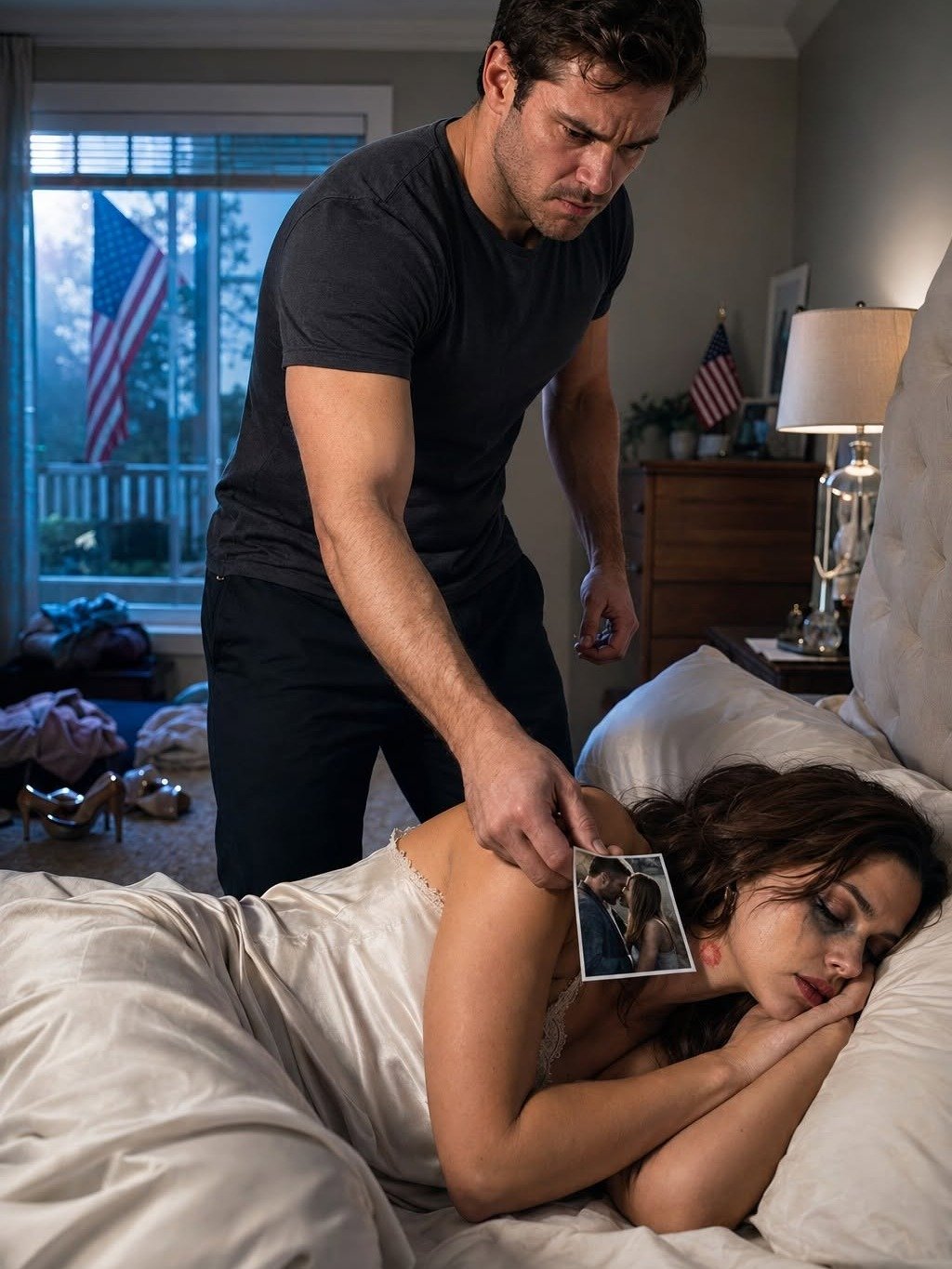
 My wife, Laura, stumbled in late, a clear kiss mark emblazoned on her neck, too blatant to even attempt to conceal. She slid into bed as if nothing had happened, settling beside the husband she mistakenly believed was too passive to react. But at precisely 6:12 a.m., I placed a damning photo on her pillow and calmly uttered, “Wake up. You forgot to hide more than just your neck.”
For a few agonizing seconds, Laura remained perfectly still.
Our bedroom was shrouded in the pre-dawn gloom, bathed in the soft, gray-blue light that signals sunrise in our quiet Ohio cul-de-sac. Outside, the neighborhood stirred with the usual morning rhythm: a pickup truck sputtering to life, a dog barking behind a fence, the gentle flutter of the small American flag on our porch against the siding.
Every sound from beyond our walls felt entirely normal.
Yet, within the confines of our room, the charade of my marriage finally crumbled.
Laura slowly opened her eyes, seemingly expecting to find me lying next to her, silent and wounded, just as I had been countless times before.
Instead, I stood by the bed, fully dressed, a cup of untouched coffee in my hand.
Her gaze drifted from my face to the photograph resting on her pillow.
Then, her hand instinctively flew to her neck.
It wasn’t a deliberate movement; it was a pure, unthinking reflex. Guilt doesn’t always manifest in spoken words; sometimes, the body betrays first.
“Evan,” she whispered, her voice barely audible. “What is this?”
I glanced at the photo, then back at her.
“You tell me.”
She pushed herself up, pulling the blanket higher around her, a futile gesture given there was nothing left for it to shield her from in that moment.
Her eyes desperately searched my face, seeking the familiar, weaker version of me—the man who would have apologized for his suspicion before she even had to offer an excuse.
But that man, I realized, I had left somewhere downstairs during the long, silent hours of the night.
“Where did you get that?” she asked, a hint of desperation in her tone.
“That’s not the question we’re addressing.”
She swallowed hard, her throat visibly working.
The mark on her neck remained starkly visible even in the dim light, a careless, almost defiant stamp she’d brought home like a scandalous receipt from a place she should never have visited.
But it wasn’t the kiss mark that chilled me to the bone.
It was the photograph itself.
And, more precisely, a specific detail hidden in its corner.
Laura looked down at the image again. Her expression shifted in rapid succession: first, confusion, then dawning fear, followed by the frantic calculation of someone trying to gauge the extent of what the other person already knew.
“I can explain,” she finally murmured.
A bitter, silent laugh almost escaped me.
For years, those three words had been her ultimate escape clause. She deployed them whenever I edged too close to an uncomfortable truth.
“I can explain why my phone was off.”
“I can explain why dinner ran late.”
“I can explain why I smelled like another man’s cologne after a work meeting.”
“I can explain why I booked a room in Columbus and told you I was staying with Megan.”
The cruel reality was, she never truly explained. She merely spoke in circles until I was too exhausted to demand the full truth, accepting a diluted version instead.
This time, it would be different.
“Start with what’s behind you in the picture,” I instructed.
Laura’s lips parted, but no sound emerged.
The room descended into such profound silence that I could hear the furnace click on downstairs. The same furnace I had personally repaired twice that winter because Laura insisted we couldn’t afford a technician, all while, it seemed, she was spending money on hotel bars and clandestine meetings.
She tentatively touched the photo with two fingers.
“Evan, please.”
“Please what?”
“Don’t look at that part.”
That was the precise moment I understood everything.
Whatever detail I had noticed in that corner was no accident. It was the crucial element she hadn’t expected me to spot, the one thing that mattered more than the tell-tale mark on her neck, more than the late hour, more than the fact that she had slipped into our bed smelling of rain, her perfume, and someone else’s expensive aftershave.
I retrieved the photo from the pillow and held it up between us.
“You arrived home at 1:47 a.m.”
Her eyes flickered, a tiny tell.
“You carefully removed your shoes before opening the door, thinking the sound would wake me. You dropped your purse onto the mudroom bench, paused there for nearly a minute, and then checked your neck in the hallway mirror.”
“Were you watching me?” she accused.
“I was awake,” I stated simply.
She averted her gaze.
That was our fundamental difference. She always posed the question that cast her as the victim first.
I took a steadying breath, keeping my voice meticulously level.
“You told me you were having dinner at Maddie’s with Megan and the girls.”
“I was,” she insisted weakly.
“No, you weren’t.”
Her grip on the blanket tightened, knuckles white.
I reached into my pocket and placed a small, folded receipt on the nightstand. Not a dramatic envelope or a thick file, just a thin strip of paper I’d discovered in the trash outside our garage, still damp from the night air.
Fairfield Inn & Suites. Polaris Parkway. 12:38 a.m.
Laura stared at it as if the paper had materialized on the table by itself, a phantom of her deceit.
“That doesn’t mean what you think it means,” she stammered.
“Then tell me what it means.”
She drew a shaky breath, her voice already cracking at the edges.
“Megan’s cousin was staying there. We just stopped by because she forgot her jacket.”
I nodded once, a slow, deliberate gesture.
“Then why did Megan text me at 5:54 this morning, asking if you got home okay?”
The silence that followed was distinct, far heavier than before.
Before, it had been laced with her fear.
Now, it was laden with irreparable damage.
Laura’s shoulders slumped slightly. Not a full surrender, but enough to indicate that her first defensive wall had finally fractured.
I had known Megan since our wedding day. She was boisterous, fiercely loyal, and utterly incapable of lying. Laura had invoked her name so many times that I finally did what I should have done months earlier.
I called her.
Not at midnight, when my anger would have made me sound unhinged.
Not at two in the morning, when I sat at the kitchen island, the receipt before me, my hands clenched so tightly my knuckles ached.
I called at 5:40 a.m., after I’d brewed coffee, after I’d printed the photo, after I’d made the firm decision that I would not raise my voice.
Megan answered on the fifth ring, her voice thick with sleep.
“Evan? Is Laura okay?”
That single question revealed almost everything I needed to know.
“She said she was with you last night,” I stated, watching Laura’s reaction.
Megan fell silent.
A car passed outside her house. In the background, a baby cried softly.
“She told me not to answer if you called,” Megan whispered, her voice barely audible.
I closed my eyes, a wave of pain washing over me.
“She told you that?”
“She said you were acting strange again. She said she needed space.”
“Was she with you?”
“No.”
“Do you know where she was?”
Another agonizing pause stretched between us.
“Evan, I really don’t want to be caught in the middle of this.”
“You already are,” I replied, my voice devoid of emotion.
Megan let out a shuddering breath, a sound of profound relief mixed with distress.
“She called me at eleven, crying. She said if you asked, I should say she stayed at my place. I told her I wouldn’t lie for her anymore.”
“Anymore?” I repeated, the word hanging heavy in the air.
That single word settled between us like a finely honed knife, placed gently on a table, its implications sharper than any blade.
Megan began to cry then, quietly, as if she had been burdened by a crushing weight for far too long.
“I’m so sorry,” she choked out. “I should have told you months ago.”
Months.
Not just last night.
Not a single, isolated mistake.
Months.
Laura watched me intently from the bed, her eyes darting, clearly wondering precisely how much Megan had divulged.
I chose not to tell her.
I wanted her to speak, trapped within the unknown confines of the room I had meticulously constructed around her.
“Who is he?” I finally asked, my voice low and steady.
Her head snapped up, startled.
“What?”
“You heard me perfectly.”
“There is no ‘he.’”
I slowly lifted the photograph once more.
She glanced at it, then quickly looked away, unable to meet its silent accusation.
The image had emerged from the printer in my downstairs office, a machine typically reserved for mundane insurance forms and grocery coupons, not for printing the devastating prelude to the end of a marriage.
The picture itself wasn’t pristine; it was grainy, a still frame captured from a security camera, forwarded to me by an anonymous sender.
At 4:18 a.m., an unknown number had sent me that single image, accompanied by six cryptic words.
“Look behind her. Not at her.”
Initially, I dismissed it as some cruel, elaborate prank.
Then, I recognized Laura in the photo.
She stood beneath the covered entrance of the Fairfield Inn, clad in the black coat she’d bought before Christmas and the silver earrings I’d given her last year—the ones she’d said she wanted for their simplicity, something she could wear every day.
Her hair cascaded loosely over one shoulder.
Her hand was touching her neck, a familiar, telling gesture.
Beside her stood a man, his face cruelly cropped by the edge of the frame.
That alone might have been enough to shatter me completely.
But the anonymous message had precisely directed my gaze.
Behind her, reflected sharply through the glass doors of the hotel lobby, another detail emerged.
Not a person.
Not a kiss.
Something far, far worse.
A blue Ohio license plate on a black SUV parked near the entrance, its reflection clear enough to reveal the first three letters.
RKL.
Ryan Keller.
Our neighbor.
My friend.
The man who had helped me carry a heavy grill onto our deck last summer, while Laura brought out lemonade and laughed a little too boisterously at his jokes.
The man whose wife, Abigail, had graciously watched our dog when we traveled to Cleveland to visit my ailing mother.
The man who shook my hand at church, called me “brother,” and shared communion with us.
I hadn’t revealed to Laura that I recognized the license plate.
I wanted to see if she would utter his name herself.
She didn’t.
“There is no ‘he,’” she repeated, her voice strained.
I turned the photo fully toward her, forcing her to confront it.
“Then why is Ryan’s SUV clearly visible behind you?”
The words landed with a palpable force, a blow I could almost physically witness.
Laura’s breath hitched for a moment. Her eyes darted to the corner of the photograph, precisely the spot she had so desperately begged me not to examine.
Outside, the sky continued to lighten, transitioning from gray to the pale blush of dawn. Down the street, a school bus groaned to a halt, its red lights blinking rhythmically against the windows of houses where families were packing lunches and urging children to zip their coats.
It felt utterly impossible that the world could continue its ordinary motion while mine had come to a complete, shattering standstill.
Laura whispered, “It’s not what you think.”
“Then what exactly is it?”
She rubbed both hands over her face, then slowly lowered them, revealing eyes brimming with tears.
“Ryan drove me there.”
I nodded once, calmly.
“That’s a start.”
“He was helping me.”
“With what, precisely?”
Her gaze flickered towards the bedroom door, a desperate, almost instinctive gesture.
I recognized that look instantly. It was the calculated assessment of someone measuring the shortest path to escape.
“Don’t,” I warned, my voice firm.
She turned back to face me, her eyes wide.
“Don’t what?”
“Don’t bolt into the bathroom and lock the door. Don’t call Megan. Don’t text Ryan. And don’t tell me I’m scaring you simply because I’m asking a calm question. Just answer me.”
Laura’s eyes welled with fresh tears, but I no longer trusted tears that preceded the truth, seeing them as another manipulative tactic.
“He was helping me think,” she finally admitted.
“About our marriage, I presume?”
“Yes.”
“At a hotel, after midnight?”
She flinched visibly at the pointed question.
“Evan, you just don’t understand what it’s been like for me.”
That sentence almost broke my composure, not because it wounded me, but because it was so achingly familiar, a worn-out refrain.
Laura possessed an uncanny ability to twist a mirror into a weapon, always deflecting blame back onto me.
When we first married, I genuinely admired her self-assurance. She could effortlessly enter a room full of strangers and make them feel as though they’d known her for years. She remembered birthdays, laughed freely, meticulously wrote thank-you cards, and knew precisely how to catch my eye across a crowded backyard party, making me feel uniquely chosen.
Everyone loved Laura.
For a very long time, I did too.
And in some deep, damaged, and utterly exhausted corner of my soul, I still did. That was the most agonizing part. Anger would have been a far cleaner emotion if love had simply died first.
But love, I had painfully learned, doesn’t always depart when respect vanishes. Sometimes, it lingers stubbornly, like a flickering light in a long-abandoned house.
“You made me feel like I was too weak to handle the truth,” I stated, recalling her subtle accusations.
Her expression shifted, a flicker of defensiveness.
“I never actually said that.”
“You didn’t have to. You communicated it perfectly without words.”
She looked down, unable to meet my gaze.
“You made me feel it every single time I asked a question and you dismissed it as insecurity. Every time I noticed something amiss and you labeled it as drama. Every time I stood in this very room, holding proof in my hand, and still felt compelled to offer you an apology.”
She began to cry harder now, her shoulders shaking.
“I was unhappy,” she choked out.
I simply waited.
There it was.
Perhaps the first truly honest sentence she had uttered all morning.
But honesty that only emerges after overwhelming evidence has been presented is still, ultimately, a form of performance.
“How long?” I asked, my voice still unnervingly calm.
She shook her head, refusing to answer.
“Laura,” I pressed, my tone unwavering.
“I don’t know,” she insisted.
“Yes, you absolutely do.”
She covered her mouth with her hand, as if to stifle a confession.
“Since September.”
September.
I felt the word slowly permeate my being, tainting every memory, every shared moment.
In September, we had gone apple picking outside Marysville. Ryan and Abigail had joined us. Laura had worn a vibrant red sweater and playfully fed me a piece of cider donut because my hands were full. Ryan had even taken a picture of us beneath a charming wooden sign that read ‘Harvest Weekend.’
That picture was still affixed to our refrigerator door.
In September, my father’s health had taken a sharp turn for the worse. I had driven to Cleveland three consecutive weekends to assist my mother with his appointments and navigate the daunting insurance forms.
Laura had claimed to understand my absences.
She had kissed me goodbye at the door, telling me to be careful on I-71.
In September, she had also started sleeping with her phone hidden beneath her pillow.
I stared at her, the full weight of her betrayal settling upon me.
“September.”
She whispered, her voice barely audible, “It wasn’t supposed to happen this way.”
“That’s a rather curious way to describe something that clearly continued to happen.”
She closed her eyes, unable to face me.
“I tried to stop,” she claimed.
I almost asked when. I almost asked why she failed. I almost asked if she ever spared a single thought for me while she was with him.
But questions like those offer no healing. They merely provide the person who inflicted the pain with more opportunities to rearrange the narrative, making it sound tragically accidental.
I picked up the hotel receipt again.
“You checked into a hotel last night.”
“No,” she denied automatically.
“Laura,” I said, her name a warning.
“We didn’t actually check in,” she clarified, a subtle but critical distinction.
“Then why is there a receipt for a room?”
“I paid for the room.”
“For who?” I demanded, the question hanging heavy between us.
She looked at me then, and for the first time since she awoke, I saw an emotion I hadn’t anticipated.
Not guilt.
Pure fear.
A genuine, visceral fear.
It wasn’t the fear of losing me.
It was fear of something far greater, something that extended beyond my reach.
“Evan,” she pleaded, her voice urgent, “you need to stop this.”
I let out a single, quiet, humorless laugh.
“I’m just getting started.”
“No, please, listen to me.”
She leaned forward, and the blanket slipped from her shoulder. Her voice dropped to a low, desperate whisper, thick with urgency.
“You don’t understand what Ryan is truly capable of.”
The name, now fully spoken, seemed to fill every corner of the room, solidifying its presence.
There it was.
Ryan.
No more anonymous man. No more shroud of secrecy. No more convenient tales of girls’ night, forgotten jackets, or fictional cousins at hotels.
I now had his name, uttered directly from her own mouth.
I should have felt a surge of victory.
Instead, I felt profoundly sick to my stomach.
“What exactly is Ryan capable of?” I asked, a new, unsettling current running through my voice.
Laura’s gaze drifted towards the window, where the American flag outside stirred gently in the morning wind.
“He knows things,” she murmured.
“About you?” I pressed.
She swallowed hard, her throat visibly tight.
“About both of us.”
I stared at her, the implication sending a fresh wave of dread through me.
“What does that even mean?”
She pushed her hair back with shaking fingers, her composure fraying.
“I never intended for it to escalate this far.”
“That, Laura, is not an answer to my question.”
“I just needed someone to talk to.”
“Ryan Keller?” I scoffed, incredulous.
“He listened,” she said simply, as if that explained everything.
“Apparently, very, very closely.” My sarcasm was sharp, a cutting edge.
Her face twisted, a flash of hurt in her eyes.
“That’s not fair.”
“No,” I retorted, my voice rising slightly, the calm façade beginning to crack. “Fair was me sitting by my father’s hospital bed while you told me you were too tired to drive up there. Fair was me fabricating excuses for you at dinner with my mother because you couldn’t stop checking your phone. Fair was Abigail bringing homemade soup to our house when you claimed to have a migraine, all while her husband was sending you clandestine messages from just two houses down.”
Laura buried her face in her hands again, a gesture of profound retreat.
I turned away from her, knowing that if I continued to look, I would either say far too much or not nearly enough.
Our room was filled with countless small, ordinary objects that suddenly seemed to scream betrayal: the framed wedding photo on the dresser, her lotion bottle on the nightstand, my watch resting beside the lamp, the quilt my mother had painstakingly made for us when we bought the house.
That was the insidious cruelty of betrayal. It didn’t merely shatter trust; it transformed every mundane object into a silent, accusing witness.
I walked to the dresser and picked up her phone.
She moved with a sudden, desperate speed.
“Don’t!”
I held it out of her reach, my hand firm.
“Passcode.”
“Evan, give me my phone back!”
“Passcode,” I repeated, my voice unyielding.
“No.”
I met her gaze, my eyes cold and steady.
“For three years, you had complete access to mine. You knew my bank login, my email password, even the code to my office. You always said married people shouldn’t hide things from each other.”
“That’s different,” she argued weakly.
“Why, exactly?”
“Because you’re angry,” she countered, trying to dismiss my actions.
“I am perfectly calm.” My voice was a chilling whisper.
“That’s what genuinely scares me,” she admitted, a tremor in her voice.
I nodded slowly, acknowledging her fear.
“It should.”
She stared at me, perhaps still waiting for the old Evan to apologize for his harsh tone, for his uncharacteristic firmness.
He never returned.
“Passcode,” I demanded again, definitively.
Her jaw tightened, a visible struggle.
“0427.”
Our anniversary.
Of course.
The phone unlocked in my hand. For a fleeting second, I despised myself for becoming this person, for knowing how to unearth what I sought, for becoming the husband who scrutinized messages, receipts, and deleted folders.
Then, I remembered that I hadn’t constructed this horrifying reality. I had merely walked into a room whose door she had carelessly left wide open.
Ryan wasn’t in her recent messages.
Neither was Abigail.
There was no obvious thread, no heart emojis, no careless late-night confession saved under his name.
Laura was far too cunning for such amateur mistakes.
I checked the hidden album feature.
Nothing.
Then, the recently deleted folder.
Still nothing.
I moved on to her email, my resolve hardening with each empty search.
She remained motionless on the bed, her eyes fixed on my every move, a silent, anxious sentinel.
I found hotel confirmations, but not in her main inbox. They were meticulously filed away in a folder she had labeled “House.”
My stomach clenched into a hard knot.
I opened it.
Three reservations.
September 18. November 3. January 22.
Fairfield Inn. Hilton Garden Inn. The Joseph, downtown Columbus.
And the most damning detail: all were booked under the name Laura Keller.
For a split second, my mind utterly rejected the name.
Keller.
Not Laura Whitman, my wife’s married name. Not Laura Hale, her maiden name.
Laura Keller.
I looked at her, the horrifying truth etched on my face.
“Evan—” she began, her voice a desperate plea.
“Why are the rooms booked under his last name?”
She began to tremble uncontrollably.
“I can explain that, too,” she insisted, the words now sounding hollow and utterly unconvincing.
“Can you, really?”
“He made the bookings,” she offered, grasping at straws.
“With your first name and his last name?” I challenged, my voice dripping with disbelief.
She rose from the bed, still wrapped tightly in the blanket, and took a hesitant step toward me.
“Please, just give me the phone.”
I stepped back, maintaining the distance between us.
Her eyes darted frantically from the screen to the bedroom door, then back to me, a desperate calculation playing out in her gaze.
That was when I noticed the second, even more alarming, discovery.
In the same folder, nestled beneath the hotel receipts, was a scanned document.
Not a photo.
Not a casual message.
A formal document.
The file name was deceptively simple.
“Plan.pdf.”
My thumb hovered over it, a sudden, cold dread seizing me.
Laura whispered, her voice cracking, “Please don’t open that, Evan.”
I looked up, meeting her terrified gaze.
“What in God’s name is this?”
Her tears flowed faster now, a torrent of fear.
“Evan, I was so scared.”
“Of Ryan?” I pressed, a new, chilling thought forming.
She didn’t answer, her silence deafening.
I opened the file, my hand steady despite the turmoil within.
The first page loaded slowly, a frustrating delay due to our perpetually weak Wi-Fi signal upstairs near the closet. I’d joked about it for years; Laura would playfully call me an old man for complaining. Ryan, our neighbor, had even once offered to help me install a signal booster.
The page finally appeared.
It was not at all what I had anticipated.
It was a property estimate for our house.
At the top, our home address was clearly listed.
Below it were stark numbers: equity, market value, estimated sale price, mortgage balance, and various “possible division scenarios.”
My throat tightened, a cold knot of fear and betrayal.
I scrolled down, my finger numb.
The second page was infinitely worse, a descent into pure, calculated malice.
A list.
Not a legal document, not even professionally typed. Just a series of bullet points, hastily jotted down in a note-taking app and then exported.
“Evan avoids conflict.”
“Evan will agree if framed as temporary.”
“Evan worries about his mother.”
“Evan fears public embarrassment.”
“Use calm voice.”
“Do not argue.”
“Let him feel responsible.”
My hand went completely cold around the phone, the metal chilling my skin.
Laura took a single, tentative step toward me, then froze, sensing the shift in my demeanor.
I reread the words, each one a fresh stab to my heart.
“Let him feel responsible.”
There are certain moments when pain swells to such an unbearable magnitude that the mind instinctively fragments it into manageable pieces, allowing the body to simply survive the shock.
First, an overwhelming wave of humiliation washed over me.
Then, pure, unadulterated anger ignited within.
And finally, something quieter, yet infinitely heavier than both: a chilling, profound understanding.
This wasn’t a reckless mistake born of loneliness. This had been meticulously managed. Carefully discussed. Systematically planned.
Perhaps not from its very inception.
But for a disturbingly long time.
I looked at the woman I had married in a quaint chapel just outside Dayton, as soft snow fell over the parking lot and my father wept tears of joy during our vows.
I looked at the woman who had held my hand so tightly at my grandmother’s funeral, offering comfort.
The woman who once drove forty minutes through a raging storm because I had a fever and desperately craved tomato soup from our favorite diner.
I looked at all those cherished versions of her and wondered, with a crushing ache, when they had ceased to be real, when the illusion had begun.
“Was this your idea?” I asked, my voice barely a whisper.
She shook her head, too quickly, too vehemently.
“Was it Ryan’s idea?”
She covered her mouth with her hand, stifling a sound.
“Laura,” I pressed, my patience wearing thin.
“He said I needed to protect myself,” she blurted out, deflecting.
“From me?” I asked, utterly incredulous.
“You were changing,” she offered as justification.
I stared at her, my gaze unwavering.
“My father was dying,” I stated, the raw grief still a fresh wound.
“I know,” she replied, her voice flat.
“Do you, truly?”
Her face crumpled then, a mask of anguish.
“I felt so alone.”
“And your solution was to construct an elaborate plan to make me believe I was the problem?” I demanded, the words cutting like glass.
“No,” she denied, but the conviction was gone from her voice.
I held up the phone, displaying the damning evidence.
“It’s written right here, in black and white.”
She reached for me, a desperate plea in her eyes, and I instinctively stepped back once more.
That gesture wounded her. I could see it. And somehow, that realization only fueled my anger further.
She could betray me for months, orchestrate a cold, calculating plan against me, yet my refusal to be touched was the injury she noticed, the one that truly stung.
“Evan,” she pleaded, “I never, ever wanted to hurt you.”
“Then what, exactly, did you want?” I asked, the ultimate, unanswerable question.
She offered no reply, only silence.
I scrolled further down the document, bracing myself.
The next page was a timeline of betrayal, a chilling chronology of dates.
“September 18: first serious conversation.”
“October 2: Evan Cleveland trip.”
“November 3: Columbus room.”
“December 15: Abigail dinner, maintain normal.”
“January 22: decision point.”
“February: refinance discussion.”
“March: separation framing.”
“April: file if needed.”
My eyes snagged on one particular line, a cold dread washing over me.
“February: refinance discussion.”
In February, Laura had indeed suggested we refinance the house.
She had sat beside me at the kitchen table, a folder from the credit union spread between us, earnestly explaining that interest rates might soon rise again, and we should seize the opportunity while we still could.
I had been utterly exhausted, my father having passed away just the week before.
She had gently touched my hand and said, “Let me handle all the details, honey. You have enough on your plate right now.”
I had almost signed those papers.
I would have signed them, had my mother not called that very night, distraught because she couldn’t locate my father’s life insurance paperwork, inadvertently delaying my signature.
I looked at Laura, a complex, unnameable emotion swirling within me—a bitter blend of horror, disbelief, and profound sorrow.
“You were going to exploit my grief to trick me into signing those papers,” I accused, my voice raw.
She shook her head violently, a desperate, frantic denial.
“No. No, that part wasn’t—Ryan said—”
“You keep invoking his name as if it somehow diminishes your own culpability,” I cut her off, my voice sharp.
She looked down, defeated.
The entire house seemed to settle around us, the silence heavy and oppressive.
For the first time, an unsettling question surfaced: how many places in my life had Ryan already infiltrated, unseen and unheard?
At our backyard grill.
In our very own driveway.
Standing beside my wife at the grocery store, when I believed she was shopping alone.
At church, three rows behind us, singing hymns beside Abigail while Laura sat innocently by my side.
Just two houses down, close enough to see our porch light extinguish each night.
I extended her phone back to Laura.
She looked genuinely surprised, her eyes widening slightly.
“Call him,” I instructed, my voice unwavering.
Her hand froze around the device.
“What?” she breathed, disbelieving.
“Call Ryan.”
“No.”
“Put him on speakerphone.”
“Evan, that is absolutely not a good idea.”
“Neither was weaponizing my grief as a strategy,” I countered, my voice devoid of mercy.
She closed her eyes, a silent plea.
“You don’t understand. If I call him, he’ll know.”
“Know what?” I demanded, sensing another layer of deceit.
“That you found the plan.”
I stared at her, the words echoing in my mind.
Her confession had just opened a door I hadn’t even known existed.
“That I found it,” I repeated slowly, letting the implication sink in.
She realized her slip, her eyes widening in horror.
Too late.
“Laura,” I said, my voice dangerously calm, “who sent me the photo?”
She immediately looked away, avoiding my gaze.
“I don’t know,” she insisted.
“Yes, you do.”
“No,” she whimpered.
“You were visibly scared before I even mentioned Ryan’s name. You were terrified of that photo before I even identified his license plate. You knew there was far more in that picture than I did.”
She hugged herself tightly, a defensive posture.
“I swear, I don’t know who sent it.”
“But you know why they sent it, don’t you?”
She remained utterly silent.
I reached for my own phone on the dresser and reopened the anonymous message.
Unknown number.
One photo.
“Look behind her. Not at her.”
I tapped the number, my finger hovering over the screen.
No profile picture. No name. No message history.
I typed a single word.
“Who?”
I didn’t press send immediately.
Laura watched me, her eyes wide with a new, raw fear.
“Don’t,” she begged, her voice barely a whisper.
Her desperate plea sealed my decision.
I pressed send.
For a full minute, nothing happened, the silence stretching taut and agonizing.
Then, my phone vibrated in my hand.
Not a text message.
A new photograph.
The second image slowly loaded onto my screen.
This one was a much closer shot, more intimate.
Not from the hotel entrance.
From inside the lobby itself.
Laura stood near the elevators, her face partially turned away. Ryan was beside her, his hand resting intimately on the small of her back, his head lowered as if whispering something close to her ear.
But once again, the anonymous message hadn’t directed me to look at them.
It had taught me how to look *around* them.
In the background, near a vending machine, someone else stood partially obscured behind a large column.
A woman.
Wearing a dark coat.
Her blonde hair pulled back tightly.
A phone clutched in her hand.
Abigail.
Ryan’s wife.
My neighbor.
My friend’s wife.
The very woman who had smiled warmly at Laura across our dining table just two weeks prior, asking if she’d like more salad.
I felt the entire room subtly tilt, my sense of reality fracturing.
Laura saw the image on my screen and sank down hard onto the edge of the bed, her legs giving out.
“She was there,” I stated, the words flat and hollow.
Laura covered her face with her hands, a sound of despair escaping her.
“She followed us,” she admitted, her voice muffled.
“She sent this?” I asked, a dawning horror.
“I don’t know,” she insisted, still denying the obvious.
I looked at the unknown number on my phone again.
A new message flashed across the screen.
“You need to meet me before he gets to you first.”
Below it, an address appeared.
Not a hotel.
Not a police station.
A diner off Route 23, about twenty minutes north of us—the kind of unassuming place with chrome stools, perpetually weak coffee, and small American flags taped in the windows around Memorial Day.
Then came one more, chilling line of instruction.
“Come alone. Bring the photo. Do not bring Laura.”
I read it twice, the implications sinking in with a cold dread.
Laura, who had been sitting, now stood up abruptly, her face pale.
“No,” she protested, her voice sharp with fear.
I looked at her, my expression unreadable.
“You don’t get a vote in this, Laura.”
“Evan, please, you have to listen to me. Abigail is not innocent in this. She’s dangerous.”
“Neither are you,” I retorted, the words sharp and unforgiving.
“She’s dangerous,” Laura repeated, her voice laced with genuine terror.
I almost laughed again, but the sound died in my throat, choked by the sheer weight of it all.
The unsettling truth about being lied to for such an extended period is that truth itself ceases to feel like a sanctuary. Every person becomes a potential trap, every warning could be genuine protection or cunning manipulation.
Laura took a step closer to me, her desperation palpable.
“Ryan told me Abigail had been watching us for weeks. He said she was unstable. He warned me that if she ever contacted you, you absolutely had to ignore her.”
“How incredibly convenient,” I murmured, my sarcasm biting.
“I know how it sounds,” she admitted, her shoulders slumping.
“Do you, truly?” I challenged.
Her voice dropped to a barely audible whisper, her eyes wide with a new, desperate urgency.
“She knows about the money.”
There it was again.
Another door, swinging open to reveal yet another layer of betrayal, far darker than I could have imagined.
“What money?” I demanded, my voice tight with a sudden, icy fear.
Laura pressed her lips together, refusing to speak.
I waited, my gaze fixed on her.
“What money, Laura? Tell me.”
She shook her head, a silent refusal.
“I can’t.”
“You can,” I insisted, my voice unwavering.
“No, Evan, I really, truly can’t.”
“Why not?”
“Because it wasn’t supposed to involve you,” she finally choked out, the words a devastating blow.
Her confession struck me with a force far greater than the revelation of her affair.
All morning, I had been convinced I was merely uncovering a marital infidelity.
Now, I understood with chilling clarity that the affair might only be the simplest, most straightforward part of this entire, complex scheme to explain.
I picked up my jacket from the chair, my movements deliberate.
Laura lunged forward, grabbing my wrist in a desperate attempt to stop me.
I simply looked down at her hand, my gaze cold and unyielding, until she slowly, reluctantly, released her grip.
“Where are you going?” she asked, her voice trembling.
“To meet Abigail,” I replied, my decision final.
“No!” she cried, a raw sound of terror.
“You should probably call Ryan and tell him to start formulating a very good explanation,” I suggested, my voice utterly devoid of warmth.
Her face tightened, a mask of grim realization.
“Evan, if you walk out that door, everything will change forever.”
I cast a final, lingering look around our bedroom, at the remnants of a life I thought I knew.
“At 1:47 this morning, you came home with another man’s mark on your neck and climbed into my bed as if I were nothing more than a piece of furniture. Everything already changed, Laura.”
She broke then, utterly and completely.
Not loudly, for Laura was never loud when genuine fear consumed her. She sank onto the bed, burying her face in her hands, her sobs a soft, broken sound that might have moved me the night before.
But the harsh light of morning had brought with it an undeniable clarity.
I could still feel a profound compassion for her pain without surrendering control of my own.
I walked downstairs, leaving her behind.
The house, superficially, appeared untouched, a silent testament to the normalcy that had been shattered.
Her purse lay on the mudroom bench, precisely where she’d dropped it. Her heels were underneath, one tipped carelessly sideways on the mat, nestled beside my sturdy work boots.
In the kitchen, the coffee maker hissed softly, a mundane sound. The sink still held two dinner plates, because I had made pasta for myself at nine the previous evening and, out of habit—foolishly, automatically, lovingly—had set some aside for her.
A yellow school bus passed outside our front window, its familiar rumble a stark reminder of a world that continued to turn, indifferent to the devastation within our walls.
Across the street, Mrs. Donnelly, completely unaware, was likely just starting her day…